
EVS in a nutshell

The European Values Study (EVS) is a large-scale, cross-national survey on basic human values that has been conducted every nine years since 1981.

With more than 47 participating countries, the EVS is the most comprehensive research project on human values in Europe. It provides unique insights into the ideas, beliefs, preferences, attitudes, values and opinions of citizens throughout Europe.

From 1981 to 2017, five survey waves were conducted in European and other countries. The surveys explore value differences, similarities and value changes among citizens of the EVS member countries. The collected data enables comparisons both over time and space and can also be combined with the data of the World Values ​​Survey. This offers the possibility to compare data from 113 world regions over a period of more than 35 years.

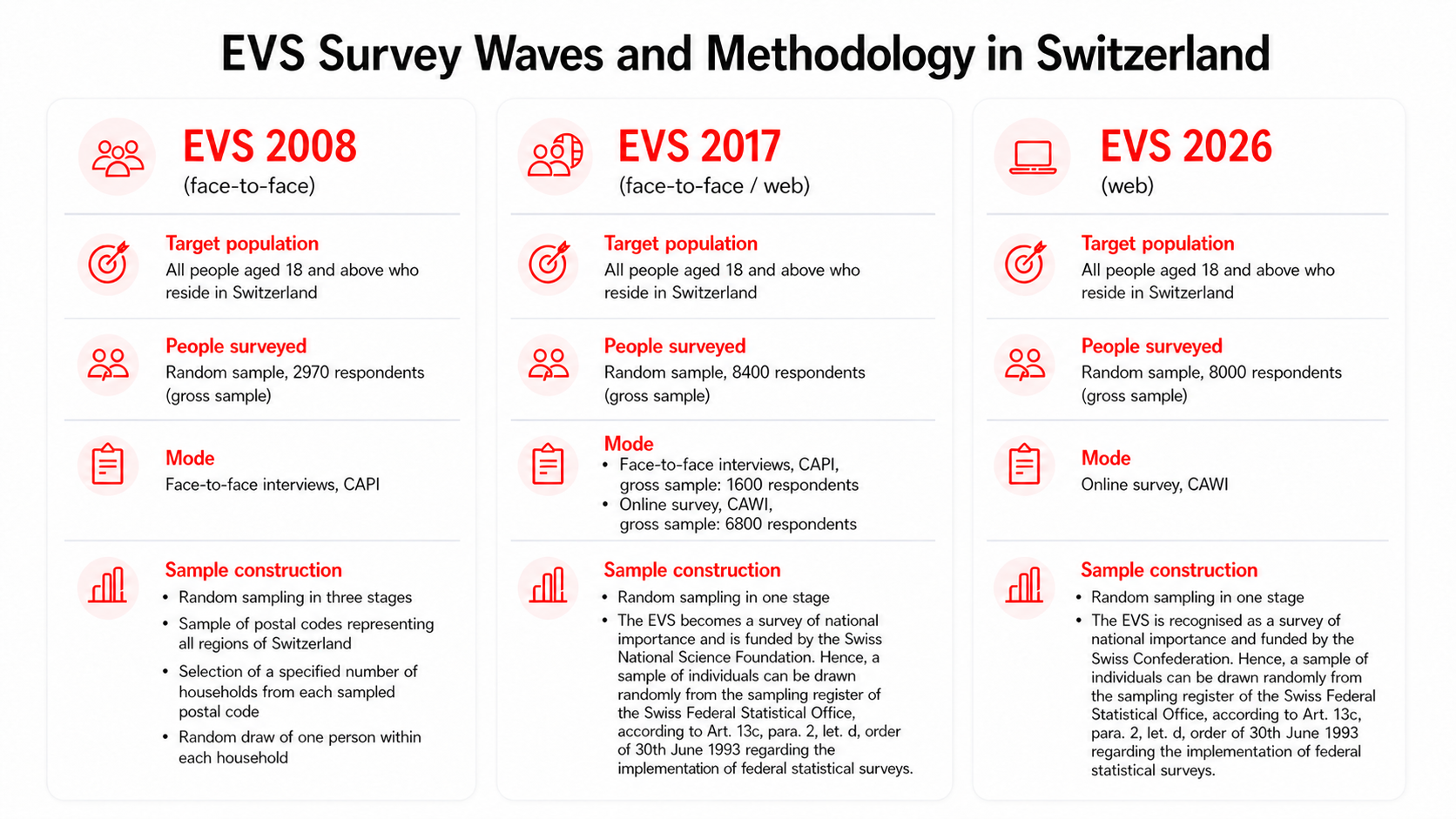
Switzerland will participate in the study for the fourth time in 2026, following its previous participation in 1990, 2008 and 2017. The planning and execution of the 2026 survey in Switzerland are funded by the Swiss Confederation within the framework of a European cooperation programme. The survey will be carried out as a self-administered online questionnaire, with a gross sample of 8,600 respondents.

 

Objectives

The main objectives of the EVS are:

  • Document social change and its consequences in Europe (e.g. processes of globalisation and individualisation). For this purpose, two thirds of the questions are repeated in each survey wave;
  • Generate a continuous series of valuable data that enables comparisons both over time and across countries in order to monitor the evolution of personal and social values across Europe;
  • Provide the scientific community with a platform that offers free access to a vast amount of high-level data and offers the possibility for the exchange of knowledge.

Structure and funding

International coordination: 

The European Values Study (EVS) was initiated in the late 1970s by the European Value Systems Study Group, an informal network of academics. Today, the EVS Foundation is coordinated by the Faculty of Social and Behavioural Sciences at Tilburg University in the Netherlands.

The European Values project is managed by the Council of Program Directors, who discuss the general outlines of the project and approve the final questionnaire and the survey method. All daily responsibilities are delegated to the Executive Committee. The Scientific Committee advises the Executive Committee on methodological guidelines, questionnaire development, substantive issues, and outreach matters.

Planning and execution in Switzerland:

In Switzerland, FORS is responsible for directing the survey. Led by Michèle Ernst Staehli, the Swiss EVS team is responsible for the translation of the English source questionnaire into three national languages — French, German and Italian — as well as sample design, the development of country-specific survey procedures, and the cleaning, processing and documentation of Swiss EVS data.

In Switzerland, the EVS 2026 is funded by the Swiss Confederation within the framework of a European cooperation programme.

Methods

Respondents are selected from a probability-based sample representing the country’s resident population aged 18 and above. While the 2017 survey wave was conducted using both face-to-face interviews (CAPI) and an online self-administered questionnaire (CAWI), the 2026 survey will be conducted exclusively online, using a self-administered CAWI questionnaire and a gross sample of 8,000 respondents.

Since the EVS is recognised in Switzerland as a survey of national importance, a random sample of individuals may be drawn from the sampling register of the Swiss Federal Statistical Office, in accordance with Art. 13c, para. 2, let. d, of the Ordinance on the Execution of Federal Statistical Surveys of 30 June 1993.

Topics / Survey waves

The European Values Study explores a wide range of human values and social attitudes. Since its first waves in 1981 and 1990, the study has covered core areas such as family and sexuality, work and leisure, religion, politics and ethics.

In later waves, the study was expanded to include topics such as solidarity, social capital, democracy and work ethics, while maintaining comparability over time. For examples of the topics studied, select one of the main domains below.

For more details on the topics studied, please select one of the main domains below.

For more information on the five previous waves of the European Values Study — including study design, fieldwork procedures, and available data and documentation — please visit:
1981 – 1st EVS wave (16 countries)

1990 – 2nd EVS wave (29 countries)

1999 – 3rd EVS wave (33 countries)

2008 – 4th EVS wave (47 countries)

2017 – 5th EVS wave (37 countries)

Data

After completion of the fieldwork, FORS reviews and verifies the data and processes it, so it can be integrated into the central data archive of the EVS (GESIS Data Archive). The pseudonymized EVS datasets are freely available to researchers and other interested people after registration and agreement to the data use conditions.

The Swiss EVS data is also available on the SWISSUbase data catalogue. The associated documentation is available in French and German.

To facilitate time series analysis, the EVS Trend File (1981-2017) was created. For comparisons at the international level, this data file can easily be combined with the World Values Survey (WVS) Trend File (1981-2022). The resulting Integrated Values Surveys 1981-2022 cover surveys conducted in 113 countries/regions.

Researchers are requested to respect the data use conditions, in particular the proper citation in articles or other types of publication. All publications that reference the data must be communicated to the EVS bibliography.

Links / further documents :

  • The international data and the associated documentation are available free of charge from the GESIS Data Archive.
  • The European Values Study website provides additional information on the origin and organisation of the study, on the participating countries, the research topics, and the questionnaires.
  • The EVS Repository provides an overview of all publications that use EVS data.
  • Publications that use the Swiss survey data must be reported to the FORS International Surveys team.

Research results / publications

Covering more than four decades, the European Values Study provides a unique view of how values and attitudes have evolved across generations in Europe. It documents shifts in areas such as gender roles and religion, while also showing where values have remained relatively stable over time, including support for democratic principles and civic norms.

Since the beginning of the project, the EVS has generated a rich academic literature on values. Scholars worldwide have used EVS data as an authoritative source for more than 3,200 publications listed in the EVS bibliography. Most publications are in English, although publications in other languages are also available.

Atlas of European Values:

The Atlas of European Values brings EVS findings to a broader audience through maps and charts. Covering countries across the European continent, it illustrates the rich diversity of values and beliefs among more than 800 million Europeans living inside and outside the European Union.