

We were saddened to learn that Professor Max Kaase passed away on 27 October 2026. Among his many contributions to the social sciences in Europe and Germany, Max Kaase also played a key role in founding FORS.


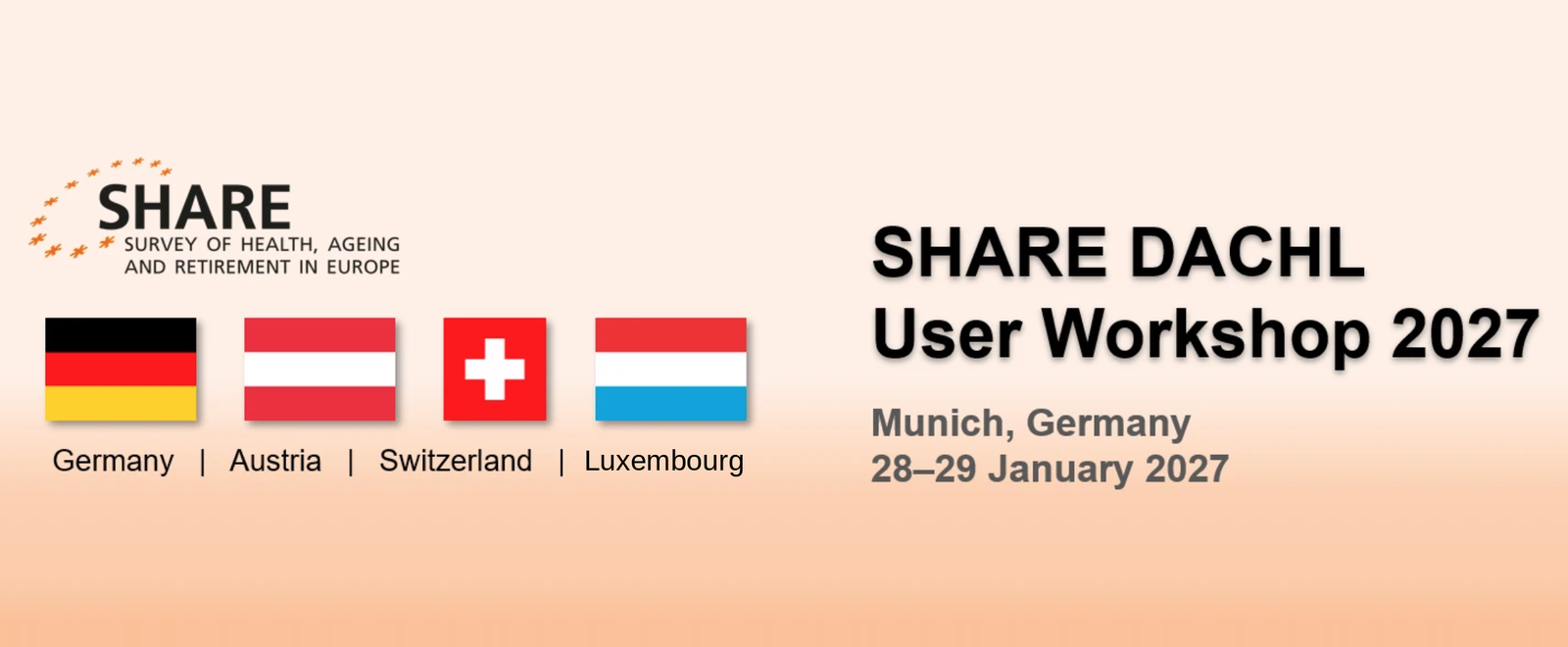
The SHARE teams from Germany, Austria, Switzerland and Luxembourg invite researchers to the SHARE DACHL User Workshop. The workshop takes place on 28–29 January 2027 at the Munich ISI in Munich.
They welcome contributions on:
-The digital transformation of retirement
-Long-term care
-Healthy ageing
-Inequalities in income, wealth and health
-Methodological and policy-oriented research
Workshop programme
A keynote by Prof. Fabian Pfeffer
Up to 12 oral presentations and a poster session
A small, focused group of 30–40 participants, perfect for in-depth discussion and networking
Workshop language: English
Key dates
• Abstract submission (max. 300 words): 15 November 2026
• Notification of acceptance: 15 December 2026
Full call for papers
Registration and paper submission
The SHARE teams from Germany, Austria, Switzerland and Luxembourg invite SHARE data users to this workshop in Munich on 28–29 January 2027. Abstracts on ageing, retirement, long-term care and inequalities can be submitted until 15 November 2026.

An open-science infrastructure that harmonizes family and employment histories across five countries, making comparative life-course research easier, faster, and fully reproducible. Explore the project and access the code on GitHub.
https://www.gesis.org/en/issp/data-and-documentation/digital-societies
The ISSP is pleased to announce the international release of the ISSP 2024 Digital Societies data file (ZA10020, v1.0.0), providing comparative ISSP data on this topic for the first time.
Join us in Lugano this November for the Research Data Management and Open Science in Social Sciences course — an intensive program for doctoral and postdoctoral researchers in the social sciences.
Over 5 days you’ll cover the full research data lifecycle: data management planning, active data curation, data ethics and privacy, reproducible research and data sharing, and data storage and security — combining theory with hands-on activities built around your own research.
Campus West, Università della Svizzera italiana, Lugano, Switzerland
9–13 November 2026
CHF 500 (free for USI PhD/postdocs)
Limited to 25 participants
Taught by experts from USI, FORS, UNIL.
This 5-day intensive course in Lugano will be taught by experts from USI, FORS, and UNIL. Designed for doctoral and postdoctoral researchers, it covers the full research data lifecycle.
Submission information
Submit your paper or session by January 15, 2027 — the conference, organized by the Swiss Household Panel (SHP) and TREE, takes place 8–9 June 2027 at the University of Bern.

Friedemann Trutzenberg and Michael Eid have published a new article based on SHP data investigating the causal effect of childbirth on spirituality. The authors found that spirituality was highly stable and that there was no average change in spirituality following childbirth among first-time parents.
Please find all the details here.
New research using Swiss Household Panel data asks: does childbirth change your spirituality?

Roland Hofmann and Michaela Tanner from the School of Management and Law at the Zurich University of Applied Sciences have published a new article on the determinants of voluntary retirement savings in Switzerland, focusing on locus of control. Although locus of control appears to play a minor role in determining the likelihood of participating in voluntary retirement savings schemes, income has emerged as a key factor.
Please find all the details here.
Locus of control plays only a minor role in voluntary retirement savings—income is the key factor.

MEDem has officially been included on the ESFRI Roadmap. It is one of six research infrastructure projects included in Europe as part of the 2026 update, and the only new one within the Social Sciences and Humanities.
FORS is a member of the MEDem consortium, contributing to the infrastructure through its role in the Service Center for Survey Data (SCSD), which coordinates survey-based research on voters and politicians across Europe. FORS Director, Professor Georg Lutz, also sits on the MEDem Board of Directors.
As MEDem Headquarters put it: “This is a major success, and it was only possible thanks to the community of researchers who have supported us along the way. Above all, this achievement is ours as a community!”
On MEDem: https://www.medem.eu/

MEDem has officially been included on the ESFRI Roadmap. It is one of six research infrastructure projects included in Europe as part of the 2026 update, and the only new one within the Social Sciences and Humanities.

Following the release of wave 26 of the Swiss Household Panel this spring, we are now pleased to present the beta version of wave 27. This preliminary data is now available on SWISSUbase: https://doi.org/10.48573/haxy-c230
The beta version of wave 27 of the Swiss Household Panel is now available on SWISSUbase.

The International Social Survey Programme (ISSP) invites researchers to submit abstracts for the 5th ISSP User Conference, which will take place online on 30 November 2026.

Do you have questions about managing and sharing your social science research data? Whether you are starting a new project, preparing a Data Management Plan, or planning to deposit your data on SWISSUbase, FORS experts are here to help.
Join Data Live, FORS’s free one-to-one online consultation service, and receive personalised guidance from experts in data management, ethics, anonymisation, documentation, and data sharing. Sessions are tailored to your needs and can support you at any stage of your research project.
The service is open to all social science researchers in Switzerland, regardless of career stage or project phase. Consultations are free of charge, held online, and available by appointment.
What can we help you with?
Our experts can provide guidance on a wide range of topics related to research data management and sharing in the social sciences, including sociology, political science, education, psychology, economics, social work, and human geography.
Topics include:
- Getting started with data management for a new project
- Completing a Data Management Plan (DMP)
- Preparing consent forms and addressing ethical considerations
- Data anonymisation and sharing sensitive data
- Documenting and organising research data
- Starting a deposit on SWISSUbase
- Understanding the benefits of depositing data with SWISSUbase
- Managing access and reuse conditions for shared data
…and any other questions you may have. No question is too small or too specific.
Practical Information
Date and time: By appointment
Location: Online
Language: English
Book a consultation now: Here
Learn more: Data Live
If you have any questions, feel free to contact us at datalive@fors.unil.ch.

Need advice on managing and sharing your social science research data? Join Data Live, our free one-to-one online consultation service, and receive personalised guidance from experts in data management, ethics, anonymisation, and data sharing.

We are pleased to announce the publication of the FORS Annual Report 2025, offering an overview of our main activities and developments over the past year.
The report highlights key achievements across our survey programmes, as well as progress in data management and archiving, with a continued focus on quality and accessibility. It also presents developments in infrastructure and IT projects aimed at strengthening research tools and user support in the social sciences.
Whether you are a researcher, policy maker, or simply interested in the evolving landscape of social science research in Switzerland, the report provides a clear and comprehensive view of our work and its impact.
We have just published our 2025 FORS Annual Report, which provides an overview of our main activities and developments over the past year.

Publication of the international data release ISSP 2023 – National Identity & Citizenship
https://www.gesis.org/en/issp/data-and-documentation/national-identity/2023
This data release covers Switzerland and 28 other member countries. It provides comparative data on national pride, immigration, citizenship, democracy, trust in institutions, globalization, and populist attitudes.

The latest data from waves 1 to 5 of the Selects panel survey are now available on SWISSUbase. This survey follows the same respondents from the 2023 federal election campaign through to the 2027 elections. Wave 5 includes current questions such as voting intentions on the initiative “No 10-million Switzerland!” as well as opinions on relations between Switzerland and the EU. In addition, several modules on affective polarization and social groups have been integrated repeatedly since 2023. Here you can access an overview of the concepts and questions included in each wave.
Selects. (2026). Selects 2023 Panel Survey (waves 1–5) (Version 3.0) [Data set]. FORS. https://doi.org/10.48573/4h6g-3p07
Further information on Selects: https://forscenter.ch/projects/selects/
The latest data from waves 1 to 5 of the Selects panel survey are now available on SWISSUbase. This survey follows the same respondents from the 2023 federal election campaign through to the 2027 elections.
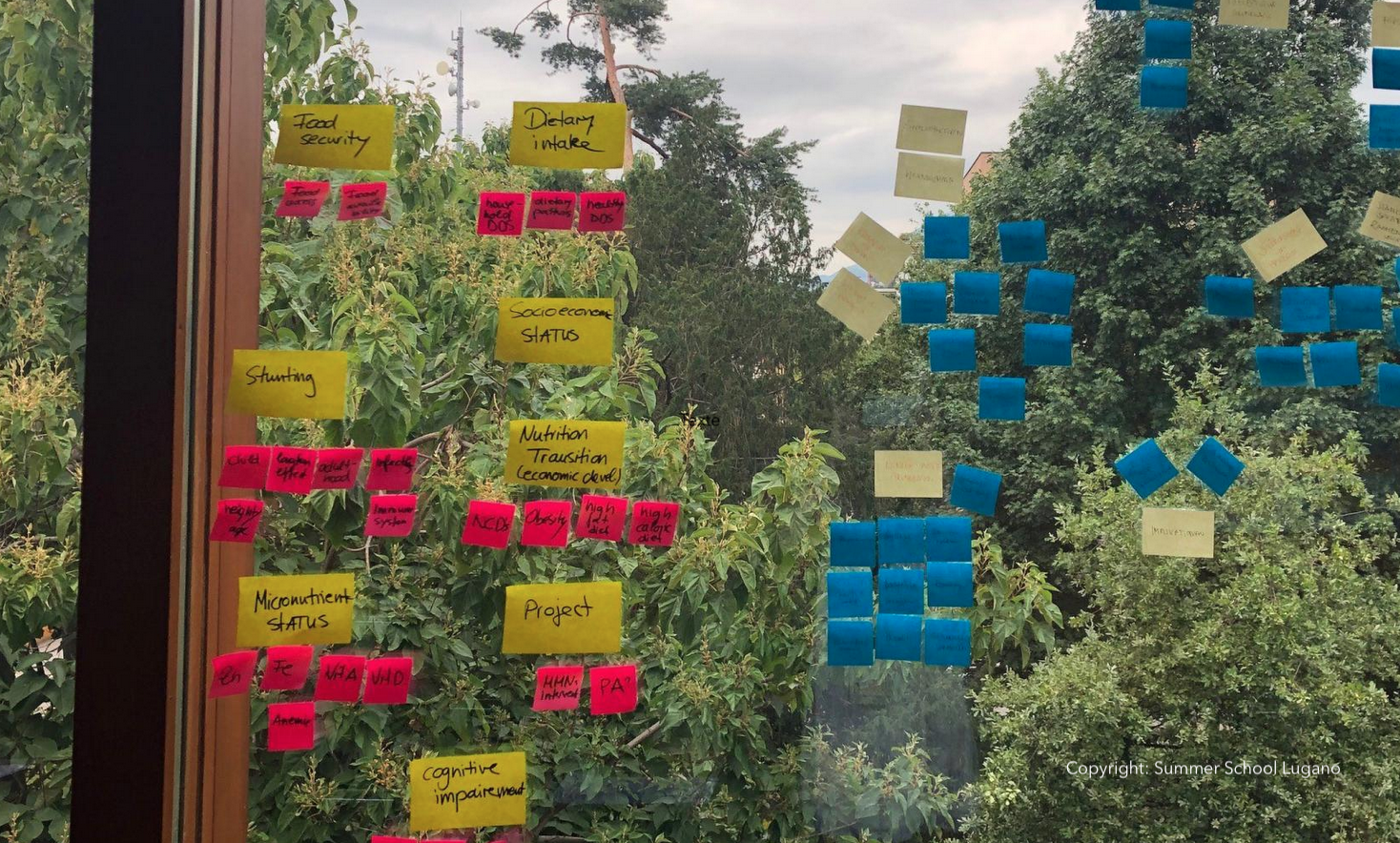
Registration is now open for the Swiss Summer School in Social Sciences Methods, which is celebrating its 30th Anniversary edition this year. With 30 specialised 1-week workshops and three preliminary statistics courses, the programme offers an excellent opportunity to strengthen methodological skills and connect with an international community of researchers.
Established in 1997, the Swiss Summer School is open to everyone working with social science methods—quantitative or qualitative—whether students, researchers, or practitioners. It is designed for anyone wishing to refresh, deepen, or broaden their methodological knowledge.
FORS will be represented by four researchers, who will teach the following courses:
→ Preliminary workshop (6–7 August 2026)
Introduction to STATA (Oliver Lipps& Ursina Kuhn)
→ Week 2 workshops (17–21 August 2026)
Longitudinal Analysis with Panel Data (Oliver Lipps & Ursina Kuhn)
Survey Design and Implementation (Michael Ochsner & Alexandre Pollien)
The Swiss Summer School in Social Sciences Methods celebrates its 30th Anniversary edition this year, offering 30 specialised 1-week workshops and three preliminary statistics courses.

We are pleased to announce the MOSAiCH Call 2027, which offers researchers a unique opportunity to collect representative data in Switzerland on relevant societal issues at no cost. We invite researchers to propose questions for the second part of the MOSAiCH Survey 2027, which will thematically complement the ISSP 2027 Social Networks and Social Resources II module. Successful submissions will be fielded in spring 2027, with data available in early 2028.
The deadline for submissions is Monday, April 20, 2026.
Further information and documentation: MOSAiCH Call 2027 or visit our webpage: https://forscenter.ch/projects/mosaich/.
MOSAiCH is a cross-sectional survey that examines the attitudes, values, and behaviours of the Swiss population towards a broad range of social issues. The first part of the survey incorporates the current module of the International Social Survey Programme (ISSP), along with selected socio-demographic questions. The second part of MOSAiCH is determined through the corresponding call and either complements the ISSP module thematically or analytically or explores other dimensions of special interest to Switzerland.
The MOSAiCH Call 2027 offers researchers a unique opportunity to collect representative data in Switzerland on relevant societal issues at no cost.

The European Social Survey (ESS) has released the final data for Round 11 (2023/24). Data from all 30 participating countries, including Switzerland, is now accessible via the ESS Data Portal.

Do you need help preparing your SHP data sets? An updated guide on data management with SPSS has been added to our website. Learn how to merge different SHP data sets, adapt the ready-to-use long file to your needs, and add information from partners or parents. You can download the guide here.
An updated guide on data management with SPSS is now available on our website. Download the guide and simplify your data preparation process.

November 3, 2025 — We are pleased to unveil our refreshed visual identity. The new logo and updated baseline reflect our growth, our strengthening partnerships, and our evolving role in advancing social science research.
Over the past seventeen years, we have expanded significantly — in staff, research projects, data infrastructure, and national and international collaborations. As a result, we recognised the need for a more strategic approach to our branding and communications.
Partnering with the Swiss agency TRIO, we undertook a participatory redesign process involving the management team, heads of units, staff members, and external partners. The aim was to refine our image, enhance coherence in how we present ourselves internally and externally, and ensure our communication better meets the expectations of our audiences.
The outcome is a comprehensive rebranding strategy that includes a refreshed mission, clarified core values, updated positioning, and — at its heart — a new visual identity. The new visual identity — including our updated logo and baseline — builds on our past to better express who FORS is today and where we’re going tomorrow.
Our new logo and brand manual can be downloaded from our website:
https://forscenter.ch/usage-guidelines/
We are pleased to launch our modernised visual identity, which reflects our evolution and aligns with our activities and ongoing development.

Are you planning a survey? FORS supports you at every stage of the process: questionnaire design, sampling strategy, data collection, statistical analysis, and dissemination of results.
Thanks to our team of methodology experts, we offer tailored services adapted to the specific needs of academic research, public institutions, and non-profit organizations.
Whether for a one-off survey or a multi-wave study, our Data Collection & Analysis (DCA) service provides recognised expertise to ensure the scientific quality of your data.
Do you have a project or any questions?
Feel free to contact us for an initial discussion or a personalised offer.
➔ More information
➔ Contact: dca@fors.unil.ch
From questionnaire design to data analysis, FORS offers comprehensive methodological support for your surveys. Contact us to discuss your needs and request an offer.

FORS is part of SENPro, a new project funded by the swissuniversities Open Science II programme.
SENPro (Swiss EOSC Node Prototype) aims to assess and prototype a national interdisciplinary node of the European Open Science Cloud (EOSC), enabling Switzerland to better connect its research data infrastructures to the European Open Science ecosystem.
The project will design a framework for interoperability, EOSC compliance, and integration of Swiss resources and services across disciplines.FORS is one of eight partners — ETH Zurich, Swiss Institute of Bioinformatics (SIB), Switch, University of Lausanne, University of Basel (DaSCH), University of Zurich, and the Swiss National Science Foundation (SNSF).
Together with SIB, FORS will co-lead work on testing prototypes with research communities, refining onboarding processes, and contributing to a White Paper on technical, service, and governance requirements.

SENPro (Swiss EOSC Node Prototype) aims to assess and prototype a national interdisciplinary node of the European Open Science Cloud (EOSC), enabling Switzerland to better connect its research data infrastructures to the European Open Science ecosystem.

Discussion Paper: Towards a Sustainable Swiss Research Infra-structure Policy, Funding and Governance Framework
Georg Lutz (FORS) and Rita Gautschy (DaSCH) have published a discussion paper addressing the current lack of a coherent funding and governance model for research infrastructures in Switzerland. They propose the introduction of a framework article in the Federal Act on the Promotion of Research and Innovation (RIPA) and suggest possible solutions for more consistent funding, governance, and monitoring mechanisms.
The proposed model includes joint funding, standardized governance structures, transparent access policies, and a coordinated monitoring framework. The authors also call for the creation of a national body to oversee RI policy and ensure coherence across the system.
This paper is an important reference for shaping future policy and ensuring the long-term sustainability of research infrastructures in Switzerland.
Read the paper: https://zenodo.org/records/15388177
This paper by FORS Director Georg Lutz and Rita Gautschy (DaSCH) is an important reference for shaping future policy and ensuring the long-term sustainability of research infrastructures in Switzerland.

The Selects cumulative dataset provides a pooled set of Swiss election survey data which covers the period between 1971 and 2023. Explore over 50 years of Swiss election surveys in one place.
Available on SWISSUbase: https://www.swissubase.ch/en/catalogue/studies/8862/latest/datasets/495/3794/overview
The Selects cumulative dataset provides a pooled set of Swiss election survey data which covers the period between 1971 and 2023.

FORS and the Swiss National Data and Service Center for the Humanities DaSCH have launched a new series of free online data management webinars for researchers in the humanities and social sciences.
The third online webinar of the FORS-DaSCH series about Data Management for the Social Sciences and Humanities will take place on May 28, 2025 (2:00-3:30PM).
It is devoted to authority data, standards and metadata. Rita Gautschy (DaSCH) will introduce you to the advantages of using authority data and standards in the humanities which ensure consistency, interoperability and discoverability across datasets. By providing unique and standardized identifiers for entities such as persons, places, and works, authority data facilitates metadata linking and prevents ambiguities. Standards such as the International Image Interoperability Framework (IIIF) for images and the Text Encoding Initiative (TEI) for the encoding of texts enhance digital scholarship by enabling structured representation, annotation, and seamless integration of images and texts. The combination of authority data and standards ensures long-term data sustainability, machine readability and enhanced scholarly collaboration across disciplines.
Auriane Marmier (FORS) will focus on metadata in the social sciences and present an overview of widely used social science metadata standards, including the Data Documentation Initiative (DDI). She will highlight the specific features of DDI that make it particularly suitable for documenting social science data and present some of the products developed by DDI, such as the DDI Codebook and the DDI Lifecycle. The presentation will then introduce controlled vocabularies and thesauri commonly used in the social sciences (e.g., ISCO for occupations, ISCED for educational levels, and ELSST for social science concepts), and explain how they contribute to semantic clarity, data harmonization, and interoperability.
The webinar will conclude with a brief comparison of metadata practices in the humanities and social sciences, highlighting both common challenges and complementary approaches.
Registration
Register here for this webinar.
Register now for the third online webinar on Authority data, standards and metadata. 28th of May (2:00–3:30pm). Hosted by Rita Gautschy (DaSCH) & Auriane Marmier (FORS).
FORS 

Bâtiment Géopolis,
5th floor Reception desk – room 5614
CH-1015 Lausanne
+41 (0)21 692 37 30 info@forscenter.ch