
FORS Data Re-use Award
Are you currently working with social science data you got from FORS? Or are you planning to do so in the next few months? Then consider submitting your paper to the FORS Data Re-use Award and get the chance to win up to 1’000CHF. The FORS Data Re-use Award is given to young researchers who carry out excellent research that is based on secondary data.
First price: 1’000 CHF
- The manuscript must be based on data accessed via SWISSUbase.
- The data were not produced by any of the authors.
- The manuscript is a full paper. It can still be a work in progress but is not yet published. The author(s) plan(s) to submit it to a peer-reviewed journal.
- Research teams can submit papers. The first author must be an early career researcher (doctoral student or postdoc).
- The dataset is properly cited.
- The manuscript is written in English.
The submission deadline for the 2026 edition is October 31.
- Innovative use of the data
- Quality of the research design
- Quality of the empirical analysis
- Originality
- Relevance/impact
- Quality of writing and presentation
- Career stage
- Composition of the research team
To address these questions, the authors implemented a data donation experiment within the FORS Connect panel, an academically led methodological online panel. The study was conducted in the second wave of the panel and involved 872 panellists, originally recruited from a probability-based sample of adults in French-speaking Switzerland using a push-to-web design.
Fielded between November and December 2022, the study provides rare experimental evidence on compliance, participant burden, and sample composition in data donation research, offering concrete guidance for the re-use of digital trace data in social science surveys.
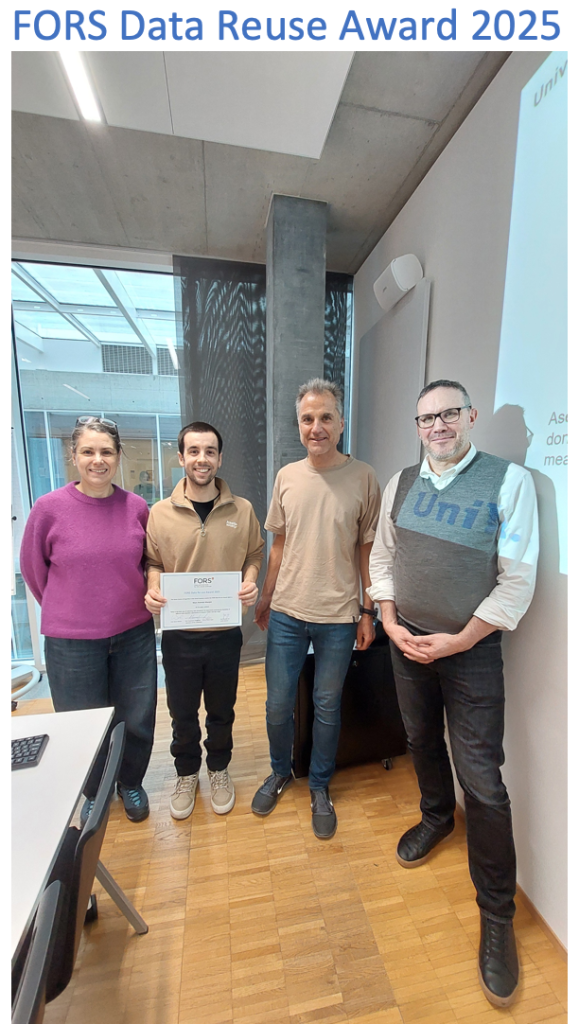
We are delighted to announce that the recipient of the latest FORS Data Re-use Award:
Nathalie Vigna PhD, post-doctoral fellow at the Department of Social and Political Sciences at the University of Milan.
For her paper: Who is ready to pay for protecting the environment? Social and spatial divides in Europe.
In her research, based on two large-scale comparative surveys from FORS, the ISSP 2020 and ESS 2016, Nathalie Vigna analyses the relationship between spatial and social stratification and willingness to pay for environmental policies. She shows consistent differences between socioeconomic groups and types of places from 13 European countries. Based on several indicators of socioeconomic position – education, class, household income – Nathalie Vigna’s research points to the fact that the least privileged groups of society are much less willing to pay higher taxes to protect the environment or mitigate climate change. This finding is observed for all the countries studied. It is also visible when using an alternative dependent variable based on a question asking people whether they would pay higher prices to protect the environment.
Furthermore, Nathalie Vigna highlights the intersection of social and spatial inequalities: willingness to pay is highest among upper-middle-class residents of urban centers, while residents of peripheral regions display lower levels of support.
Nathalie Vigna’s research further contributes to the knowledge of environmental policy support by showing that these differences are only partially explained by the different levels of environmental concern or different beliefs about climate change across the social hierarchy. Her research has important implications for public policy, as raising awareness of climate change is not enough to make the most vulnerable people willing to contribute through personal costs. Environmental policy-makers can only seek public consensus by addressing social inequalities or providing progressive compensation.
The data underlying their research is available on SWISSUbase:
–https://www.swissubase.ch/en/catalogue/studies/13102/latest/datasets/929/1396/overview
–https://www.swissubase.ch/en/catalogue/studies/13953/latest/datasets/1232/2079/overview
The article will be published soon.
Save the date
Nathalie Vigna will present her paper at the FORS Lunch Seminar on February 4, 2025.
All information on the FORS Lunch Seminars can be found here.
We are delighted to announce that the recipients of the latest FORS Data Re-use Award are:
Anna-Lena Nadler and Elif Naz Kayran, for their exceptional paper entitled “Local alien enfranchisement and external efficacy perceptions: intended and unintended effects on non-citizens and citizens”.
Examining the Swiss Household Panel data from 1999 to 2014, the authors investigate the impact of local alien enfranchisement on political influence perceptions among citizens and non-citizens. Findings indicate that inclusive enfranchisement policies heighten non-citizens’ sense of political influence without diminishing citizens’ efficacy. This highlights the potential of such policies to foster immigrant integration in diverse democracies.
We encourage you to read their paper published here.
The data underlying their research is available on SWISSUbase https://doi.org/10.48573/58nw-6a50.
First prize
Rita Schmutz (LIVES, University of Lausanne)
Inequality of Educational Opportunity in Switzerland: Exploring Regional Differences and Institutional Factors
The data can be found here: https://www.swissubase.ch/de/catalogue/studies/13413/18252/overview
Second prize
Mengling Cheng (LIVES, University of Lausanne)
The data can be found here: https://www.unil.ch/share/de/home.html
Second prize
Alessandro De Boni
Youth enfranchisement in Switzerland: an analysis from the Swiss Election Studies Selects (Master thesis)
The data can be found here: https://www.swissubase.ch/de/catalogue/studies/8862/18944/overview





Congratulations to Marc Asensio Manjon, winner of the FORS Data Re-use Award 2025.
The FORS Data Re-use Award 2025 is awarded to the article:
“What is the best way of collecting data donations?An experiment assessing the feasibility of different data donation approaches to measure mobile and app usage”. The study provides concrete evidence on how to maximise compliance and reduce bias in data donation studies—an important advance for survey methodology and the re-use of digital trace data in the social sciences.
Read the article: https://www.tandfonline.com/doi/full/10.1080/1369118X.2025.2570738
The data underlying this article are openly available on SWISSUbase.